
Curtain Wall Systems Compared: Unitized vs Stick vs Spider Glazing
The same building can wear three completely different curtain wall systems. How unitized, stick and spider glazing differ in cost, speed, performance — and how to spec the glass for each.

- The same building can wear unitized, stick or spider glazing — cost, speed and maintenance trade off differently in each.
- Glass specification is driven by the wind-load calculation and climate, not by the system type.
- Unitized locks glass tolerances in at the factory; stick absorbs site tolerance; spider makes hole quality structural.
- Ask for fragmentation, heat-soak and IGU dew-point evidence before facade glass ships.
- Order 2-3% spare panels per type inside the same production batch — a same-batch spare is invisible in color; a replacement a year later is not.
What a Curtain Wall Actually Is
A curtain wall is a non-structural outer skin hung on the building frame: it carries only its own weight and the wind and seismic loads acting on it. Because it wraps the whole building, the glazing choice multiplies — a 5% improvement in glass performance across a 20,000 m² facade outweighs almost any other single specification decision.

Unitized Curtain Wall: Factory Precision, Crane Speed
Unitized systems arrive as pre-asculated modules — frame, glass, gaskets and spandrel pre-assembled in the factory — that cranes hang floor by floor. Site labor shrinks, quality control moves indoors, and installation races ahead (a trained crew can close in hundreds of square meters a day). The trade-offs: modules need protected storage, transport logistics matter, and field modifications are difficult. See our unitized curtain wall glazing package.
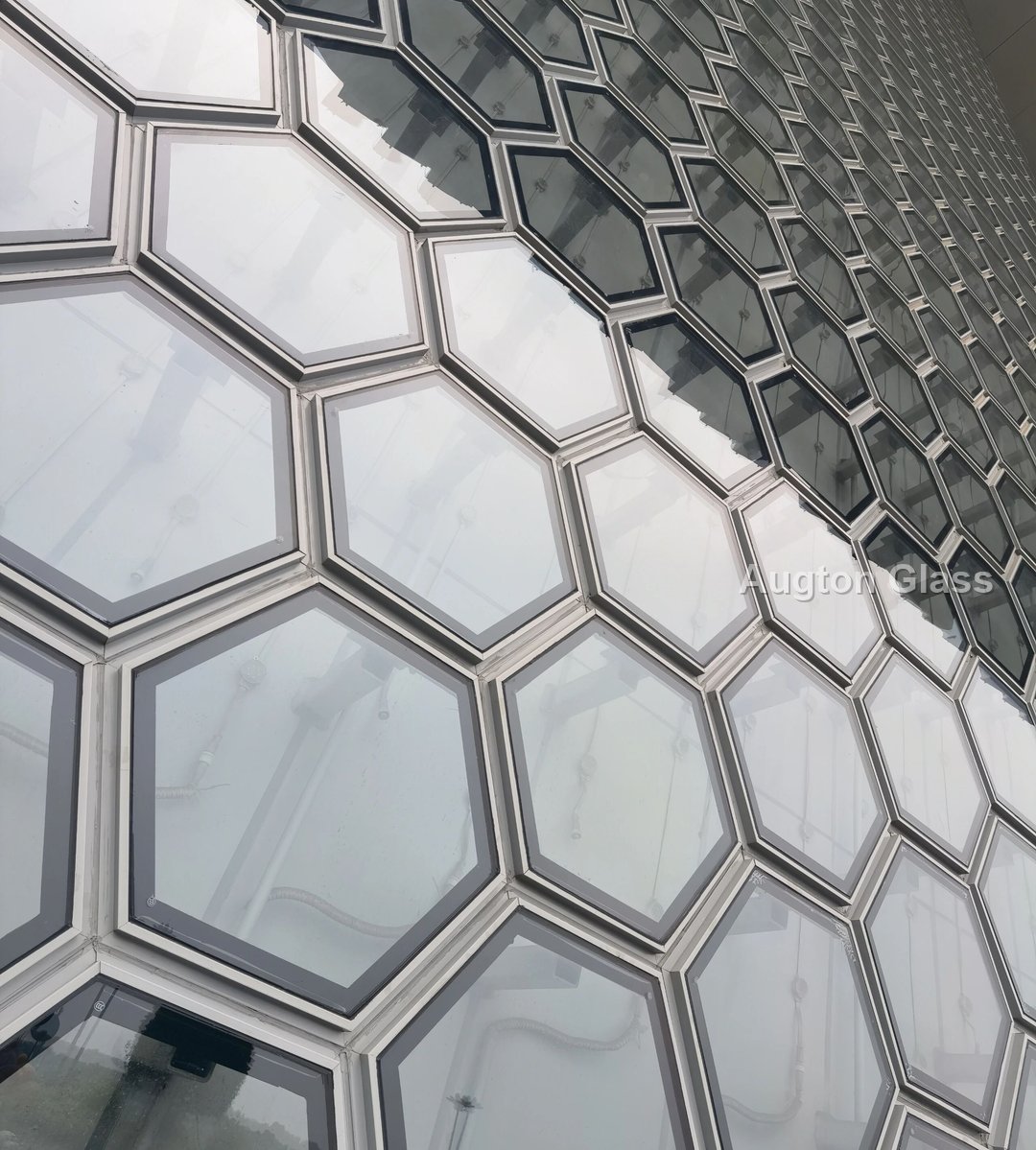
Stick System: Flexibility on a Budget
Stick systems ship as loose mullions and transoms assembled vertically on site, with glass installed panel by panel. The upfront system cost is lower, containers pack tighter, and site tolerances are absorbed by the assembly process — reasons the stick method still dominates mid-rise and price-sensitive projects. The costs are the mirror image: quality depends heavily on site workmanship and installation takes longer, with scaffolding or mast climbers through the build. Our stick curtain wall supply covers the full glass schedule.

Spider Glazing: Maximum Transparency
Where the brief is glass almost without frame, spider fittings bolt glass panels to a supporting steel structure — cables, fins or trusses. Spider curtain wall delivers the lobby, atrium and airport look: open corners, minimal sightlines, dramatic height. The engineering is more specialized (point-fixings create local stresses the glass must be designed for) and usually pairs with oversized glass fins as the vertical support instead of mullions.

Glass Specification Differences Between the Three
- Unitized: glass sealed into modules in the factory — insulated glass units with dual-seal systems are standard; dimensional tolerance must be tight because the module locks it in.
- Stick: glass glazed on site with pressure plates and caps — panels are individually replaceable, a maintenance advantage, but site glazing quality varies.
- Spider: tempered or tempered-laminated glass with drilled point-fixing holes and countersinks — hole quality is structural, so it happens only in controlled factory conditions.
- All three: solar control (low-E, reflective or solar-control glass) is chosen by climate and orientation, not by system type.
- All three: replacement planning differs — unitized modules replace as a unit, stick glazing swaps single lites from the outside, spider panels need fitting access planned from day one.
- All three: spandrel zones (hiding slabs and structure) use opacified or printed glass matched to the vision-glass coating so the facade reads as one surface.
Choosing Between Them
| Criterion | Unitized | Stick | Spider |
|---|---|---|---|
| Typical building | High-rise, repeat floors | Mid-rise, complex geometry | Lobbies, atria, skylights |
| Site installation speed | Fastest | Slowest | Project-specific |
| Quality control | Factory (highest) | Site-dependent | Factory glass + engineered steel |
| System cost | Highest | Lowest | Engineering-intensive |
| Maintenance | Module-level | Panel-level replacement | Panel + fitting inspection |
How We Fit Into Your Facade Package
We manufacture and supply the glass element of all three systems — tempered, laminated, coated and insulated units — with the drilling, notching and edge work that point-fixed and module glazing demand, plus the processing capabilities (heat-soak, edges, silk-screen) high-rise facades require. Facade glass ships in racking crates engineered for site craning.
The Performance Numbers Behind a Facade Spec
Three numbers dominate facade glass specification. U-value (thermal transmittance): a 24-28 mm double insulated glass unit with a low-E coating sits near 1.0-1.6 W/(m²·K); triple glazing reaches 0.6-0.9 where energy codes push hard. SHGC (solar heat gain coefficient): coatings tune it roughly 0.25-0.45 — lower for hot climates and west orientations, higher where winter solar gain is welcome. VLT (visible light transmission) trades against both; 40-60% is the usual comfort band for offices. Acoustic performance adds an Rw figure: 32-40 dB for standard IGUs, high-30s to mid-40s when one ply is laminated. None of these depend on whether the facade is unitized, stick or spider — the system decides how the glass is held; the numbers decide what it does.
Quality Gates Before Facade Glass Ships
- Tempered panels: fragmentation testing per batch — particle count and size in the code-mandated zone.
- Heat-soak testing where specified: panels hold at about 290 °C for two hours to flush nickel-sulfide breakage risk on structural and high-level glazing.
- IGUs: dew-point testing to EN 1279-2 practice, seal cross-section checks, and gas-fill verification on argon-filled units.
- Flatness and optical distortion measured on coated glass — small roller waves multiply visually across a full floor of repeat panels.
- Color and print consistency checked panel-to-panel against the approved master across the entire batch, not just the first crate.
Order 2-3% spare panels per type inside the same production batch, from the same coating lot. Site breakage is a schedule question, and a spare from the same batch is invisible in color — a replacement produced a year later can sit noticeably off next to weathered neighbors.
Logistics: Sequencing Glass to the Site
Facade glass arrives in the order the crane needs it, not the order the factory finished it. Unitized glazing is packed per module grid with floor-and-position labels on every crate; stick-system panels are crated by elevation segment so a floor's worth of glass arrives together; spider panels travel in individual crates with hole protection and fitting sets bagged to the panel. Export projects get packing photos before loading and per-crate manifests, so the site can stage crates without opening each one. Ask for the packing drawing together with the quotation — it costs nothing and prevents the most common site complaint: the panel you need tomorrow is at the back of the container.
Frequently Asked Questions
Which curtain wall system is cheapest?
Stick systems have the lowest material cost, but total project cost can close the gap once site labor and schedule length are counted. High-rise repetition is where unitized pays for its higher factory cost.
What glass thickness do curtain walls use?
Common IGU builds are 6-10 mm panes laminated or insulated to the project's wind-load calculation — 24-32 mm total units are typical. The structural calculation, not habit, should decide.
Can spider glazing provide thermal insulation?
Yes, when built with insulated glass units and thermally broken fittings — standard in modern airports and office lobbies. Single-glazed spider walls remain common where the space is unconditioned.
Why do spider systems use tempered-laminated glass?
Point fixings concentrate stress, so tempered glass handles the loads — and lamination keeps fragments in place if a panel ever breaks above occupied space. Hole drilling and countersinking happen before tempering, in the factory.
Do you supply facade glass for export projects?
Yes — we export curtain wall glass packages worldwide, including heat-soak tested tempered units and oversized panels in engineered transport racks. Send the glass schedule for a per-panel quotation.
Can you match glass for an existing facade repair?
Usually yes — send a sample panel or the original build-up specification with dimensions. Coating lots age differently, so we test color against your sample and advise honestly on batch matching for visible elevations versus service areas.
How long does a facade glass package take to produce?
Standard tempered and IGU panels: 3-5 weeks after drawing approval. Heat-soaked, drilled spider panels or oversized lites: 5-8 weeks. Production is planned against your installation sequence so crates arrive in install order rather than production order.
Who is responsible for glass breakage in transit?
It follows the freight terms: under FOB the ocean leg is on your forwarder's insurance, under CIF ours covers it to your port. Either way, photograph crates at receipt before signing — documented transit damage claims resolve quickly, undocumented ones rarely.
Can different systems mix on one building?
Constantly — unitized on the repeated tower floors, stick where geometry is irregular, a spider wall at the lobby. What must stay consistent is the glass: same coating family and edge details across systems, or adjacent elevations will read as different buildings.
The Bottom Line
Send your facade glass schedule — we will price the full package, flag any panels outside standard tolerances, and propose packing for site craning.
Request a Quote →


