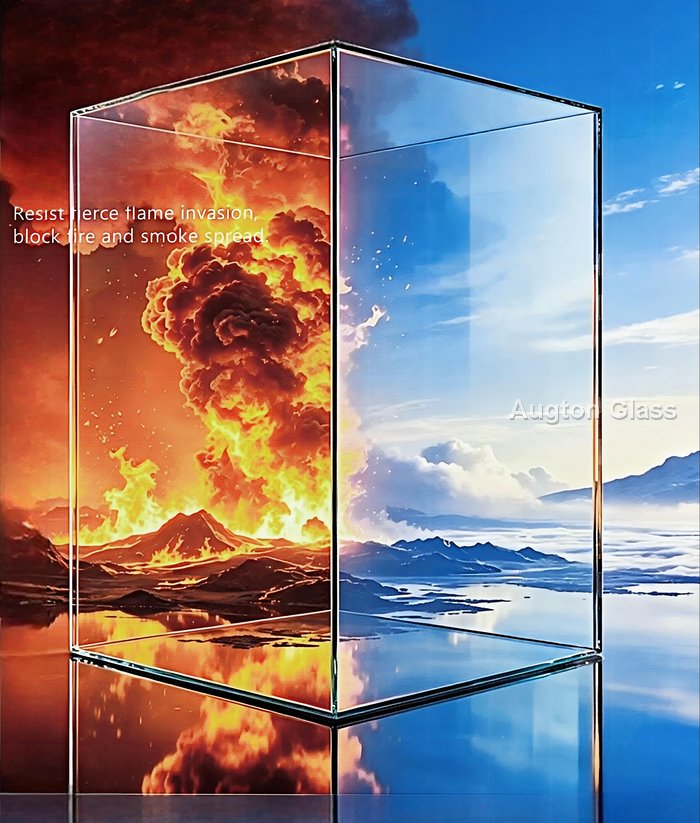
Fire-Protective vs Fire-Resistive Glass: What Specifiers Get Wrong
Both types pass a fire test, but only one blocks radiant heat. Confusing the two is one of the most expensive mistakes in glazing specification — here is how to tell them apart and choose correctly.

- Fire-protective glass holds flames and smoke (E ratings); fire-resistive glass also blocks radiant heat (EI ratings).
- Match the glass rating to the wall or door assembly requirement — EN 13501-2 E/EW/EI or UL 10C / ASTM E119 — not to the biggest number on a label.
- Glass-ceramic covers most fire-protective openings at 20-180 minutes; intumescent laminates deliver true EI insulation ratings.
- The frame, seals and glass must be tested together as an assembly; rated glass in an unrated frame fails inspection.
- All cutting, notching and drilling must be factory-completed — any on-site modification voids the listing.
Two Different Questions, Two Different Products
Fire-protective glass answers the question "will the glass keep flames and smoke out for X minutes?" Glass-ceramic panels and traditional wired glass are fire-protective: they hold the opening against fire for 20 to 180 minutes, but radiant heat passes straight through. A hand held near the unexposed face would burn within seconds.
Fire-resistive glass answers a second question: "will the assembly also stop the heat?" These multi-layer intumescent laminates meet the same integrity rating plus an insulation criterion — the unexposed face stays below the temperature rise limits of ASTM E119 or UL 263. They are what codes require where glazing forms part of a fire barrier wall.


Where Codes Draw the Line
- Door vision panels, transoms and sidelites next to doors: fire-protective glass-ceramic is typically accepted, often 20-90 minute ratings.
- Fire windows in exterior walls with distance separation: fire-protective is usually sufficient.
- Interior fire barriers, stairwell enclosures and area separation walls over size limits: fire-resistive (insulated) glazing, commonly 60-120 minutes.
- Any location with occupancy-safety limits on glazing area in a rated wall — most codes cap fire-protective glass at small dimensions precisely because it does not block radiant heat.
The Materials Behind Each Type
Monolithic glass-ceramic (5 mm) has near-zero thermal expansion, so a wall of flame on one side does not crack it. It handles thermal shock, can be sandblasted or filmed without losing its rating, and stays optically clear with no green tint — a major upgrade over old wired glass. Our glass-ceramic line is tested to UL 10C positive-pressure and hose-stream criteria.
Film-backed glass-ceramic adds an impact-safety layer for door vision panels that must meet ANSI Z97.1 or CPSC 16 CFR 1201 Categories I/II.
Intumescent laminated glass (8 mm and up) contains clear gel or intumescent interlayers that turn opaque and insulating when heated — that is what delivers the E/I fire-resistive ratings and partial radiation control (EW ratings).
The Error That Costs the Most
The classic failure: a specifier buys 60-minute fire-protective glass for a rated corridor wall because the label says "60 minutes." The product passes its integrity test but does not satisfy the E119/UL 263 temperature-rise requirement of the wall assembly — and the whole assembly fails inspection. Ratings only transfer to an assembly when the glass, frame, glazing seals and hardware are tested together as a system. Always match the glass rating to the wall's rating requirement, not just the minutes on the label.
Practical Selection Checklist
- Start from the wall or door assembly rating in your code — the glass must match it, not exceed it pointlessly.
- Check whether the code calls for integrity only (E) or integrity + insulation (EI).
- Confirm impact-safety requirements where people can strike the glass (doors, low windows).
- Verify the frame system carries the same fire rating — rated glass in an unrated frame is a failed assembly.
- Order all cut-outs, notches and drilling factory-completed: fire-rated glass cannot be modified on site without voiding the listing.
Ratings Vocabulary: E, EW and EI Compared
North American practice expresses the same split through ASTM E119 / UL 263 temperature-rise requirements and UL 10C or NFPA 252/257 fire tests, while European practice uses EN 13501-2 classes and EN 1364/1365 assembly tests. Whatever the system, the physics is identical: integrity alone does not limit the infrared energy that passes through clear glass-ceramic, and only intumescent interlayers — which foam into an opaque insulating char at 120-160 °C — can hold the unexposed face cool enough for EI performance.
| Criterion | E (integrity) | EW (radiation control) | EI (insulation) |
|---|---|---|---|
| Blocks flames and hot gases | Yes | Yes | Yes |
| Radiant heat on unexposed face | Uncontrolled — can exceed 15 kW/m² | Limited, typically below 15 kW/m² | Restricted — face temperature rise capped (EN 13501-2: average ≤140 °C, single point ≤180 °C) |
| Typical build-up | 5-6 mm monolithic glass-ceramic or wired glass | Film-backed or laminated glass-ceramic | Intumescent laminated glass, 8-30 mm multi-layer builds |
| Glazed area in rated walls | Small openings only — codes cap dimensions | Larger openings permitted | Largest permitted areas, full wall-height glazing |
| Relative cost per m² | Lowest | Moderate | Highest — multiple interlayers add material and weight |
Glazing Installation Details That Preserve the Rating
A fire rating lives or dies in the glazing pocket. Rated systems specify exact edge cover (commonly 8-15 mm per edge depending on system), setting block positions, and intumescent glazing tape or sealant between glass and frame. Substitute a decorative silicone bead for the specified intumescent seal and the assembly test result no longer applies — this is the second most common inspection failure after wrong glass selection, and it is invisible at handover until the AHJ asks for the assembly documentation.
- Verify the frame system listing covers the glass type, rating and orientation you are installing.
- Check glazing rebate depth and edge cover against the system drawing before any glass arrives on site.
- Install setting blocks and intumescent tape exactly as detailed — positions and widths are part of the tested design.
- Set panels without forced edge pressure; glass-ceramic needs clearance for thermal movement even though its expansion is near zero.
- Apply the specified intumescent sealant or tape bead and finish within the system's stated dimensions.
- Photograph the completed pockets and file rating labels plus certificates for the inspection record.

Weight, Cost and Lead-Time Realities
Budget planning improves with honest numbers. Monolithic 5 mm glass-ceramic runs about 12.5 kg/m² and is the economical workhorse for doors, transoms and vision panels. Intumescent EI builds stack multiple glass plies and gel interlayers — a 60-minute insulated unit commonly sits near 25-35 kg/m², and 120-minute builds go heavier still, which affects both frame capacity and handling. Expect fire-resistive glazing to cost several times the equivalent fire-protective area, with lead times driven by interlayer supply and assembly testing — order rated glass packages early in a project because they cannot be improvised late.
Send the AHJ's requirement (E, EW or EI, and minutes) plus the opening schedule rather than asking "for 60-minute glass." Quoting the wrong class is the most expensive way to save a phone call — the difference only shows up at inspection.
Inspection and Maintenance Over the Building's Life
- Keep rating labels permanently visible and legible — inspectors look for them first.
- Inspect glazing seals and intumescent tape annually; degraded sealant must be renewed like for like, never with decorative silicone.
- Replace any cracked or chipped rated panel with an identical listed product — a damaged fire pane is a failed barrier even before a fire.
- Never retrofit films, tints or coatings onto rated glass unless the film carries its own listing for that system.
- Re-check clearances after any door hardware changes; adjusted closers and hinges can change how the assembly behaves in a test condition.
What We Supply
We manufacture glass-ceramic fire-rated panels in 5 mm monolithic, film-backed and 8 mm laminated builds, with sizes and ratings detailed on our fire-rated glass product page. For legacy retrofits where impact safety is the only requirement, wired glass remains an economical option. All production steps — cutting, edgework, filming, laminating — happen in-house under our quality process, so assemblies stay traceable.
Frequently Asked Questions
Is fire-rated glass the same as wired glass?
No. Wired glass is the traditional fire-protective product — the embedded wire mesh holds cracked glass together during a fire. Modern glass-ceramic achieves the same integrity ratings with better clarity, higher strength and no wire pattern, and is now the standard choice.
Can fire-rated glass block smoke?
Yes, when installed with intumescent glazing seals in a rated frame — the glass itself is only one component of the smoke-rated assembly.
Why does fire-protective glass have a size limit in rated walls?
Because it transmits radiant heat. Codes limit the glazed area in fire barrier walls so that heat radiating through the glass cannot ignite materials or endanger occupants on the other side.
Can I cut or drill fire-rated glass on site?
No. All cutting, holes and notches must be factory-completed before the product leaves our plant; on-site modification voids the fire listing.
What documents come with an order?
Each batch ships with test-report references (UL 10C, EN 13501-2, BS 476 as applicable), rating labels and a certificate of conformity for submission to your authority having jurisdiction.
Which standard applies to my project — EN 13501-2 or UL 10C?
It follows the project's code jurisdiction. European and many Middle East specifications use EN 13501-2 E/EW/EI classes; North American projects use UL 10C / ASTM E119 criteria. Tell us the project location and authority, and we quote the tested product line that matches — mixing classes across systems is not permitted.
Does fire-rated glass need maintenance?
Minimal but not zero: annual inspection of seals, labels and glass condition, plus immediate like-for-like replacement of any damaged panel or sealant. The glass itself needs no coating or cleaning regime beyond normal glass care.
What is the lead time for EI fire-resistive glazing?
Longer than standard glazing because intumescent builds are made to order with system-specific frames and hardware. Plan 4-8 weeks depending on rating and size; early confirmation of the opening schedule protects both price and delivery.
The Bottom Line
Send us the wall rating and opening schedule — we will confirm which rated build-up applies and quote per panel within 24 hours.
Request a Quote →